From the January 2026 issue of Deb’s Quill
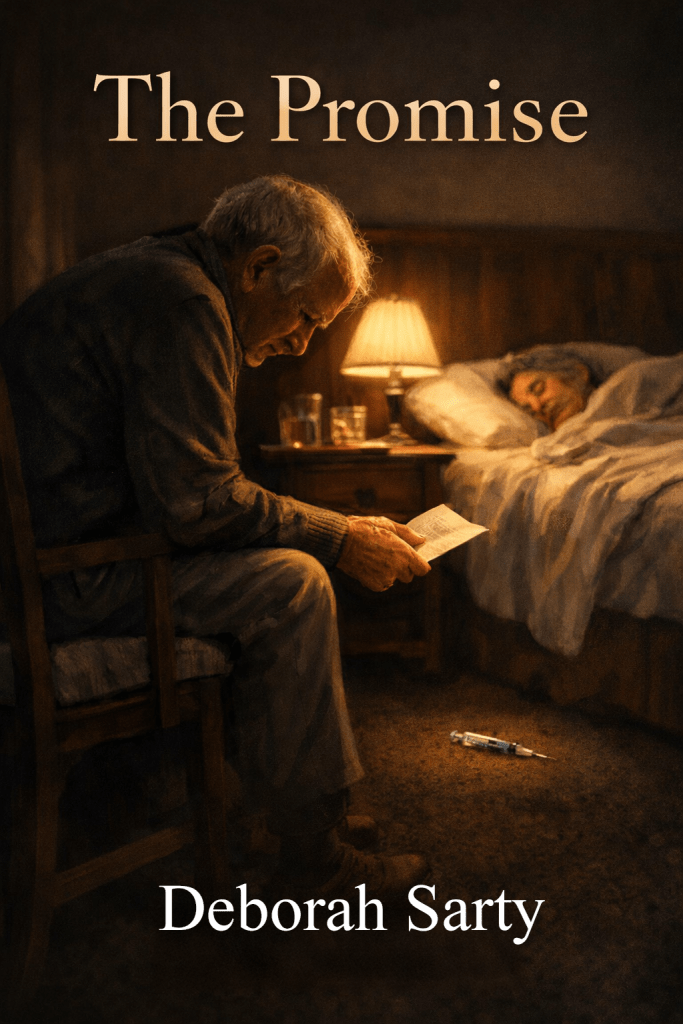
THE PROMISE
Some changes are easy to dismiss—until the day they refuse to be ignored.
August 2025:
Charlie slumped on the front steps of his Brookhaven, Connecticut home, the letter in his trembling hand. Beauregard, his aging golden retriever, lay with his head draped over Charlie’s thigh. Dogs always know when their masters need comforting.
“Don’t be sad, Beau,” Charlie said, stroking the dog’s silky head. “It’s been a long five years, hasn’t it?”
He glanced up to their darkened second-story bedroom window, closed so their central air could keep the nighttime heat and humidity at bay. He shouldn’t be out here, not with his high blood pressure. Already his shirt was sopping, and the sweat coating his face masked his tears.
“I don’t know if I can keep my promise, boy.”
June 2020:
Charlie stood at the front door, leash in hand. “Come on, Beau. Let’s get that walk in before the heat melts us into the sidewalk.”
Beau bounded up to him, tongue hanging out, tail wagging, body quivering. Gladys trailed behind.
“Can you pick up some dog food while you’re out?” she said, her hand on his arm. “If it’s not too much to carry.”
“I’m old, Gladys,” he huffed, “but not that old. I’ll pick up the damn dog food.”
She leaned in and pecked his cheek. “Don’t be offended. I’m just worried about that hip of yours. It already hurts like the dickens after each walk. I don’t want this chore to make it worse.”
“Nonsense.” Charlie clipped the leash to Beau’s collar, “You hear her, boy? She thinks I’m a rickety old man.”
“Oh, for heaven’s sake,” Gladys said, then turned on her heel and headed for the living room.
Charlie laughed. “She’s too easy to annoy, isn’t she, boy?”
“I heard that,” Gladys shouted.
But Charlie and Beau were already out the door.
They made it only a block before Beau tugged hard enough on his leash that it slipped out of Charlie’s hand. “Come back here, Beau,” he scolded, and hurried to where the dog was sniffing the rose bushes. He retrieved the leash just as Mrs. Peters came outside.
“Don’t let him pee on my bushes, Charlie Willick.” She marched down the steps, broom raised. “I swear that dog of yours thinks my bushes are a bitch in heat, the way he goes after them.”
“I know.” He retrieved the leash and told Beau to sit. “You sure you’re not hiding drugs in those bushes, Mrs. Peters?” he teased. “Maybe Beau was a drug dog in a past life.”
She whacked her broom across his retreating legs. “That’s a terrible thing to say, Charlie Willick. I’ve half a mind to tell Gladys on you. She’ll set you straight.”
Charlie laughed. “She’s been trying to set me straight for forty-five years. Hasn’t worked yet.”
They reached Main Street a block later, passing Kingsley and the rich aroma of coffee from Lola’s Cafe, then the Chiropractic Office and all the way to the end, to Northumberland Fine Foods.
Charlie looped Beau’s leash around the light pole, then straightened, massaging his back. He sighed, wishing he’d brought the car. “Stay here, Beau.”
He found Annie at the back. “I need a two-kilogram bag of dog food. You mind getting it for me, young lady? I’m sorer than a marathoner after a race.”
Annie’s head tilted to the side. “Again? Your wife was here yesterday, got the dog food and left without paying.” Her face scrunched. “Sorry, Mr. W. I guess she had a lot on her mind. I’m sure she didn’t mean to.”
Charlie took a step back and winced as pain shot down his leg. “Gladys? My Gladys? That doesn’t sound like her at all.”
“I know, right? She taught me math a few years ago, and all.” She touched his arm and laughed. “We had to be so careful never to lie to her, ‘cause she never forgot, and she’d throw our words back at us if we didn’t keep our stories straight.”
“Hmph. Don’t I know it. Memory like a hard drive with no delete button.” Charlie pulled his cell out and dialled home. It took him two tries as his swollen, arthritic fingers kept hitting the wrong keys. But finally, it rang through—only, Gladys didn’t answer.
“Okay, Annie, well, I’ll talk to her when I get home. Forget the dog food. I can always pick some up tomorrow if this is all a mistake. But here,” he said, pulling out his wallet. “Let me pay what we owe.”
Transaction complete. Charlie headed outside and untied Beau. “No park today, boy. Annie’s got me all confused. Me and Gladdy need to have a chat.”
Back home, he found Gladys in the living room, knitting a Onesie for Ethan, their soon-to-be grandson.
“You sent me on a wild goose chase, Gladdy,” he said, sinking into his recliner.
“Well, then, tell me you caught one and we can have it for dinner.” She peered at him over the top of her glasses with her schoolmarm look.
“Ha ha. I walked the extra blocks to the market for dog food, and Annie said you picked it up yesterday.”
“Of course, I picked it up yesterday. But I didn’t ask you to pick any up today. That would be silly. You hallucinating on me, Charlie?”
“Well, I’m not imagining that you stole the dog food yesterday. Walked right out without paying.” He tossed the wadded-up receipt at her. “Annie said. I paid today, and that’s the receipt to prove it.”
“Hmph. I’ll have a word with Annie. Because I most certainly did pay yesterday.” She set her knitting aside and rose, face pinched the way she looked when she was annoyed. “I’ll fetch the receipt, though you should know me well enough by now to believe me.”
She searched everywhere but didn’t find the receipt.
Charlie tried not to, but couldn’t help smirking when she admitted defeat.
“Don’t you dare,” she said, and turned her back on him. Then muttered under her breath as she walked away, “This getting old is sure getting old.”
“One of us is,” he joked.
She rounded on him then, eyes blazing. “You want to put your money where your mouth is, Mr. Smart Guy? You want to pit your memory against mine?” She marched to him and poked his chest with her finger. “Against mine?”
“Ow. Jeepers. I was just kidding.”
“Well, I’m not. You forget more in a day than I have in my lifetime. Always have.”
“Do not,” he said, though he knew it was true.
“Then prove it.” She marched to the kitchen and returned with two mason jars, grabbed two Post-It notes and a pen, and labelled the jars as His and Hers. “Every time you forget something, I put a nickel in your jar. You do the same for mine.”
“And what do I get when I win?” he asked, pretending bravado. “Besides the pleasure of rubbing it in.”
“If I win, we’ll spend Christmas at my sister’s.”
“That’s spiteful,” he groused. “But that’s fine. I can be mean, too. If I win, you have to watch hockey with me all winter. Sit through every game without complaining or calling the game stupid.”
They sealed the deal with a handshake that radiated her anger up his arm.
December 2021:
December arrived by burying Brookhaven under a smothering blanket of heavy, wet snow. Charlie helped his grandson Ethan build a snowman. In truth, Charlie did most of the building while one-year-old Ethan stuck handfuls of snow in random places. In the end, the snowman looked like how Charlie felt: wet, lopsided, with bits falling off. But Ethan loved it.
They came inside, sopping, cold—exhausted and yet exhilarated—to the smell of pot roast and apple pie, and the sound of Sara and Gladys singing and dancing. Beau lay on his stomach, watching Gladys, whining in time with the music.
“She’s stolen my dog,” Charlie complained to Tony. “He doesn’t want to walk with me anymore. I have to drag him away from here and wrestle him out the door.”
Tony patted his father on the back. “It’s the cold, Pop. I’d fight you, too, if you tried to put a leash on me and drag me outside.”
After dinner, the adults retired to the living room with coffee and pie. Sara wandered over to the bookshelf. “What are these jars for?” she asked.
“A bet,” Charlie answered, forking the last piece of pumpkin pie in his mouth.
“Really? Who’s winning?”
Charlie joined her. “Let’s see now.” He emptied both jars and counted the nickels. “Me, fifteen. Gladys, ten.” He looked over, brow creased with dread. “Looks like you won, honey.”
Gladys frowned. “I did? What did I win?”
“You don’t remember?”
She shook her head. “Something about hockey, maybe?”
Charlie dropped another nickel in her jar and winked at Sara. “You said you didn’t want to make Christmas dinner this year. If you won, we’d have it at Sara and Tony’s.”
May, 2023:
Charlie and Beau arrived back at the house at dinnertime. The cool spring air swirled apple blossoms around his front yard, and he sighed, resigned to spending tomorrow raking them up.
Beau strained at his leash, eager to get inside to Gladys. She was feeding him something special; he was sure of it. Steak maybe? She was hiding it well, whatever she was doing, because his searches failed to figure out her secret. But something she was doing had stolen his dog’s loyalty.
He refused to be annoyed, not today. Gladys had promised him lasagna and chocolate cake for dinner. Not necessarily in that order. He’d reminded her this morning, not that she’d forget his seventy-fourth birthday. But he’d been checking her nickel jar lately, and hers now had more coins than his—so he wasn’t taking any chances.
“Gladdy, I’m home.” He followed the sound of her singing—Yesterday, one of his favourites. He danced his way into the kitchen, pressed himself against her back and wrapped her in a bear hug. “Smells wonderful, honey,” he said, nuzzling her neck. “Dance with me? The way we used to when we met.” He grabbed her hand and spun her around into his embrace. “Slow, sensual, and heading to the bedroom.” His swaying steps backward had her laughing.
She kissed his cheek and pulled away. “In your dreams, Casanova. The cake is still in the oven. I don’t want it to burn.” She tossed a sly look over her shoulder. “Although I don’t imagine you’d take very long.”
“That’s just mean,” he muttered as he wandered off to watch hockey.
Half an hour later, she had his birthday dinner on the table: a pan of lasagna in the middle, flanked by salad and a bread basket.
Charlie dug in immediately but kept his portions small so he’d have room for cake.
“Excellent, honey. As usual.” He gathered their plates and took them to the kitchen, bringing the cake and dessert plates back with him.
“Now for the best part.” He reached for the cake knife, but Gladys slapped his hand away.
“Hold your horses, hon,” she said. She placed two giant candles on the cake, a 7 and a 4, and lit them. “Okay. Now you make your wish. Then you get a slice.”
I wish for my dog back.
He blew out the candles and cut himself a huge slice, and one half its size for Gladys. He tucked in, shovelling the largest piece possible into his mouth. And immediately stopped chewing. The cake was—bitter? Chocolatey, for sure, but he struggled not to pucker. And forced himself to swallow, followed by chugging half his glass of water.
“You forget something in the cake, Gladdy? Take a bite.”
She did, and her face scrunched. “That’s not right.”
“I think you forgot to add sugar, hon.”
Gladys bristled. “Don’t be ridiculous—hon. It’s probably the chocolate. Must have turned.” She marched to his side, grabbed his plate and the cake and carted them back to the kitchen. Then she marched to their bedroom and returned with his present. “Here.” She thrust it at him, like it was his fault the cake was ruined.
The box was the right size and shape. Let it be a new phone. Grinning, he tore the paper off and nearly yelped in delight when iphone was printed across the box. His fingers trembled as he opened the box.
“What the hell, Gladdy,” he yelled. “This is not the time for jokes. Where’s the phone?”
Gladys peered over his shoulder to find the box empty. Her hand flew to her mouth. “Oh, dear.” She sank into the seat beside him, tears in her eyes. “Someone stole your present.”
He softened at her distress. “Nonsense. It probably just fell out of its box when you weren’t looking. I bet it’s in the bedroom. On the bed or maybe on the floor.”
He stood and tugged her to her feet. “Come on. Let’s go look for it.”
On the way by, he dropped two more nickels into her jar.
December 2024:
A winter wind howled outside, rattling the windows, cracking small branches, and whistling down their chimney. The flames in the fireplace danced and sputtered, then surged again.
Tony and Sara had put their two kids to bed and retired themselves. Charlie didn’t think it was to sleep, not from the way the two of them were looking at each other. He and Gladys used to look at each other that way. A smidgeon of envy aside, he was glad they were visiting.
He’d been pointing out Gladys’s decline for months now, only for Tony to brush his concerns off. “It’s just old age, Pop. You forget things, too.”
Charlie glanced at the two nickel jars. Glady’s was nearly full, and his was only a quarter as much. Yes, he forgot things. No, Glady’s issue was not the same. And during Glady’s lucid moments, she knew it, too.
“Sara, honey, do you mind making dinner tonight?” she asked earlier. “It’s my arthritis. It hurts too much to stand for long.”
But Charlie knew the truth. He’d taken over most of their cooking, and they’d started ordering in more, because Gladys kept messing up the recipes, missing ingredients for dishes she’d been making for decades, or burning casseroles because she forgot what the timer was for.
He’d meant to insist that Gladys cook this weekend—so Tony would finally see—but he’d melted at the plea in her eyes, and caved.
Well, it was late, he was tired, and he felt off, his blood sugar too high. He’d test, but he knew the feeling. And knew how hard his diabetes was to control when his stress was out of control.
He stretched, rose from the couch and held out his hand. “Come on, Gladdy,” he said, taking her hand and pulling her up. “Time for bed. Let’s get you your pills. And I need to test my sugar levels.” He nudged a sleeping Beau awake. “Come on, boy. Get your head off Gladdy’s feet so she can walk.”
“Come on, Beau,” Gladys said, petting the dog’s head. “Time for bed.”
She slipped her arm around Charlie’s waist and squeezed. “These love handles of yours are becoming shelves, love. We need to find a way to eat healthier. Like Sara’s dinner tonight.”
They walked arm in arm toward the stairs, Beau trailing behind Gladys. “Maybe it’s time for Meals on Wheels,” Charlie answered. “What do you think?”
“Hmm. Maybe. Or maybe one of those services that deliver the ingredients to your door, with preparation instructions. What do you call them?”
“Can’t remember,” he said. “But yeah, maybe try that first.”
Gladys tugged him to a stop by the bookshelf and dropped a nickel into Charlie’s jar.
“You set me up,” he complained.
Gladys chuckled. “Yes, I did.” But her laugh died out, and a tear slid down her cheek. “I don’t like the look of mine. It’s too full.” She stopped, faced him, and took his face in her hands. “It shouldn’t be this full, love. Should it?”
He hugged her close. “I think it just means I listen to you more than you listen to me,” he lied, his voice soothing, “so I catch your slips more than you catch mine.”
They stood still for minutes, Beau leaning against Gladys’s legs.
“Nice try. But I know I used to have an excellent memory. So this is—not right.” She sniffled into his chest. “I think it’s time I get tested.”
“We’ll both get tested,” he said, kissing the top of her head, his throat closed with the effort of fighting back his own tears.
Later that night, Beau jumped on the bed, straddled Charlie’s sleeping form, and pawed frantically at the covers until Charlie woke up.
“Beau? What the hell?”
Beau raced to the bedroom door and stood expectantly, then raced back to the bed and barked.
“Need to pee, Beau?” Charlie swung his legs out of bed and slid into slippers and a housecoat. He reached back to pat Gladys’ hip—and found her spot empty.
“Gladdy, you in the bathroom, honey?” He headed there, needing to pee badly, himself, but Beau grabbed a mouthful of housecoat and tugged Charlie to the window.
Below, Gladys stood on the sidewalk, wind whipping her flimsy nightgown around her legs, her feet bare against the frosted concrete, hair dancing. Charlie threw open the window and hollered. “Gladdy, what are you doing out there? Come inside immediately. You’ll freeze.”
If she heard him, she didn’t react, just kept staring up the street.
Charlie grabbed the afghan off her rocking chair and rushed for the stairs, pounding on Tony’s door as he ran. Outside, he wrapped the blanket around her and tried to steer her back indoors, Beau nudging her with his nose.
She pulled away from him. “Stop that, Dad. I’m waiting for Tony. He should be home by now. It’s a school night, and it’s past his curfew.”
“Honey, it’s me, Charlie. Your husband.” He tried to put his arm around her again, but she shook him off.
“Get away from me. Who are you?”
“Pop, what’s going on?” Tony rushed down the porch steps, trailed by Sara and Ethan. “Mom?”
Gladys rushed to Tony and threw her arms around him. “Charlie, this man is attacking me. I’m out here looking for Tony, and he’s trying to drag me—somewhere.”
Tony looked over her shoulder at Charlie, brow furrowed, eyes questioning.
Charlie scooped Ethan up in his arms and took Beau by the collar. “Let’s all get inside before we turn into ice cubes,” he said. He leaned close to Tony’s ear and whispered.
Tony nodded and turned to his mother. “I saw Tony upstairs, Gladdy. Asleep. Must have snuck past you.” He shifted so his arm was around her shoulder. “Come inside now. It’s too cold out here.”
Charlie poured three shots of whiskey while Tony put his mother to bed, Beau following anxiously behind, and Sara did the same with Ethan.
Charlie meant to wait for them. He did. But he downed all three shots in rapid succession. Then picked up the half-empty bottle and heaved it at the sink, where it shattered. Glass flew everywhere, a sliver grazing his cheek as it arced past him. Crunching glass beneath his feet, he stomped to the closet for the broom, but ended up pounding the door until his fist was raw, the pain snaking up his arm to shake his brain out of its rage. He sank to the floor, spent, oblivious to the shard piercing his butt, knocked his forehead against his knees, and cried.
That’s how Tony found him. Charlie’s eyes were bleak as Tony removed the broom from his hand and swept up the glass. And stayed bleak as Tony grabbed a new bottle, poured a shot, paused over a second one, shrugged and poured it too.
He brought both glasses over to the closet and sank beside his father. “I see you’ve had three of these already,” he said, handing the other glass over, “but I guess you can probably use this one too.”
“Thanks, son.” Charlie downed it and set the glass aside.
“What the hell, Pop?” Tony leaned into his father’s side, shoulder to shoulder. “I’m sorry, I didn’t believe you. I had no idea.”
Charlie shrugged. “First time it’s been this bad. Some signs, like losing her sense of smell, happened a decade ago. Who knew? In the last several years—mostly, just asking the same question over and over again. And forgetting things like how to balance her chequebook.” His voice was strained. “I paid a fortune in bank overdraft fees until I figured out what was happening and hid it.”
“I’m sorry.”
Charlie shrugged. “Not your fault.” He wiped his nose on his sleeve, grimaced at the mess, then ignored it. “I saw the same thing happen to her mom. But I refused to believe it was happening to Gladdy.”
“Nana, too? I didn’t know.”
Charlie looped his arm through Tony’s. “We hid it from you. Didn’t want you to see your grandmother that way. Maybe that was a mistake.”
“Maybe. But I was pretty young when Nana died. Just—what?—fourteen?”
“Hmm, sounds about right. Here, help this old man up, will you? Pretty sure I’m sitting on a piece of glass and my butt is screaming at me.”
They took the whiskey bottle and glasses to the living room, once Charlie’s butt was cleaned up.
“Gladdy noticed the jars earlier today. Really noticed them. Wants to get tested. She has these lucid moments, and earlier was one of them. She knew. I knew she knew, but I couldn’t handle the idea. And then—this—just now. Complete break from reality.”
“Scared the crap out of me,” Tony said, and gulped down more whiskey.
“Me too, let me tell you. If it hadn’t been for Beau waking me up …”
“Yeah.”
Charlie’s laugh was hollow. “At least, I finally found her secret. I thought she’d lured Beau away from me with food, but I could never catch her doing it. But tonight—Beau, looking out for her—I get it. He knew before I did that she was sick.” He downed the glass and reached for the bottle. “Wish I could speak dog. Though I don’t know I’d have done differently, even if I’d known.”
Tony nodded, and downed his own glass. “So, what now?”
“I don’t know.” Charlie tipped his head back against the sofa and sighed. “Guess I’m getting tipsy. Am I spinning? Or is the room?”
Tony slid down to the floor, prone. “Did this room always smell like booze?”
“Gladdy’d have a fit if she could see us now,” Charlie chuckled.
“Sara’s gonna skin me alive if I crawl into her bed stinking of whiskey. Think I’ll just sleep here.”
Charlie glanced at the nickel jars, and his voice broke. “When your Nana died, Gladdy took it so hard. She made me promise, you know.” He cried, great hiccuping sobs. “I never thought Gladdy would get the same thing. So I agreed. Now I’m terrified she’ll ask me to keep it.”
Tony crawled to his father and laid his head against his knee. “It’s okay, Pop. It will be okay.”
Quiet settled around them, the whiskey bottle pushed to the side. Charlie dozed off to the sound of Tony snoring.
Tony jerked beside him, jarring him awake.
“What promise, Pop?”
“Doesn’t matter.” He rose, wobbled and held onto Tony to steady himself. “I’ll sleep in the den tonight, in case your mother still doesn’t know who I am.” He patted Tony’s shoulder. “Don’t worry, son. I’ll call our insurer in the morning, get your mother the help she needs.”
January 3, 2025:
Charlie put the phone down with a heavy heart. Pinehill Residence had a bed for Gladys. He had 24 hours to accept. He would, of course. What other choice was there? Gladys’d had a few more good days these past weeks—but most were bad.
He’d bought special locks for both doors so she couldn’t slip outside while he slept; he’d even unplugged the stove so she wouldn’t accidentally burn the house down when he wasn’t looking.
But the hardest part? Gladys not knowing him and recoiling from his touch. He missed her. Missed holding her, talking to her. Being with her.
This woman sharing the house with him—she looked like his Gladys, but she was a stranger. And he’d never felt so alone in her company.
Stop feeling sorry for yourself. Gladdy has it far worse.
Sniffling, he fetched her Living Will. He’d need to give it to the Care Home. She’d made it after her mother’s passing. That had been an awful time. For Gladys, mostly, her mother’s principal caregiver, but also for him. But this was worse.
He debated whether to read it. Gladys’s instructions had been clear. If she were diagnosed with Alzheimer’s or dementia, she wanted no medical intervention of any kind except to alleviate pain or fear.
But the will was a reminder of when she’d been herself, so he unsealed it and pulled the will out. A sheet of her stationery fell from between its pages. Her handwriting. He hesitated, his finger tracing the first words, “Dearest Charlie.” A tear dropped, smearing his name, but he kept reading. It was the last coherent message he’d ever receive from her, and he’d cherish it.
“I love you with all my heart, sweetheart, but if you’re reading this, then I’m ill. If it’s dementia, then you know what I want. Keep your promise to me, honey. Help me go now. And I’ll wait for you on the other side.
Love forever, your Gladdy.”
He heard her stirring upstairs and tucked her letter and Will away, tears streaming. Then went about his day caring for this stranger who used to be his wife.
That night, he sat in the chair beside her bed and wept himself to sleep. But an hour later, when she stirred, he woke with a start. But it was a false alarm. She dropped back asleep, but he couldn’t.
He picked up his laptop and started a different kind of search—one he shouldn’t have on his computer, but he didn’t care. He’d promised, and she’d never forgive him if he backed out.
He decided on insulin because it was handy and familiar. He’d wear the plastic gloves she used when dying her hair. It took him a half hour to assemble the tools. Then he filled a new needle with as much insulin as it would hold and replaced the tip cap.
And then sank onto a chair, momentarily paralyzed.
How could he do this? How could he even think of doing this?
Her final letter replayed in his mind. When she wrote it, Gladys was adamant about not suffering through the later stages of Alzheimer’s. How could he not honour her wishes? How could he not keep his promise?
He rose and carried the syringe to the bed. Gladys slept deeply. He risked climbing into bed beside her, keeping a thin space between them, the syringe clutched in his hand. He rested his hand on her hip, tentative, waiting for her reaction, his muscles tensed, ready to pull away if her body rejected him. But she sighed and leaned into his warmth. He cried, his tears soaking her nightgown, his hand still clutching the syringe.
Her words rang in his head. “You promised.” He had. And he’d always kept his promises to her. But this?
How could he?
And yet—how could he not?
His thumb moved to the tip cap.
Just flip it off. It’s easy. The needle will slide into her buttocks. She’ll never feel a thing.
He lay like that for—what?—minutes? An hour?
And still he couldn’t do it.
Not tonight. He let the syringe fall between them, and fell asleep holding tightly to Gladys. Maybe tomorrow.
The End
© Deborah Sarty. All rights reserved. This story may not be reproduced without permission.
Enjoyed this story? New short fiction appears first in Deb’s Quill, my free monthly newsletter.
 Deb's Quill