From the December issue of Deb’s Quill
FRANK
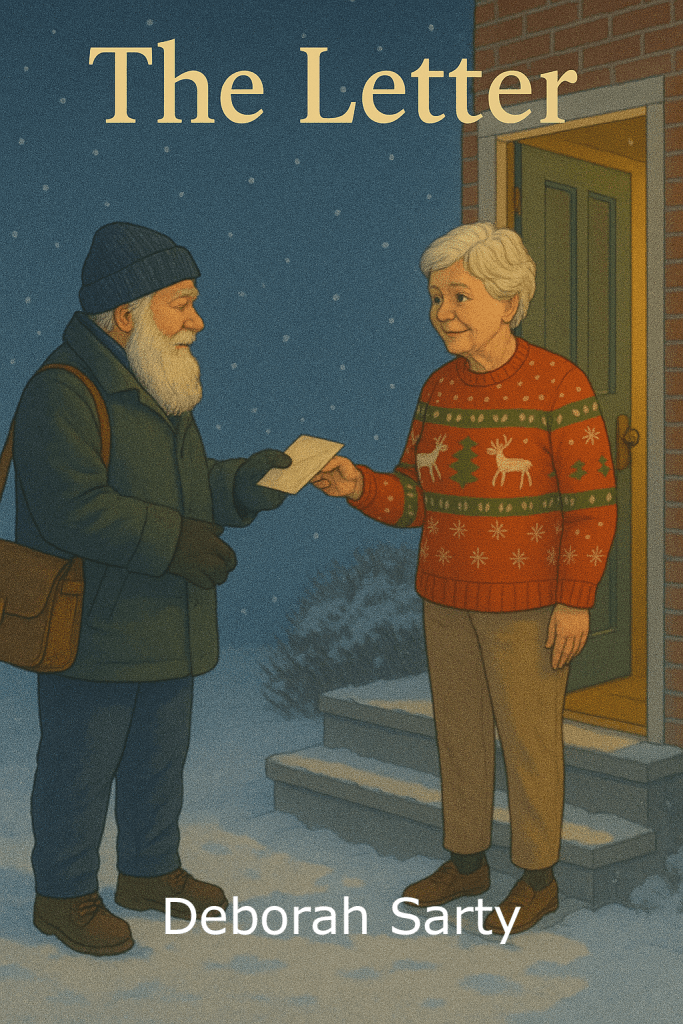
Frank Daly sat at his kitchen table. The morning sun slanting across the checkered tablecloth, highlighting the crumbs from his toast. He pushed his plate aside and pulled the old leather mailbag onto his lap. It smelled faintly of dust and wool, the way it always had after the Christmas season. For thirty-five years, he’d slung this bag across his shoulder, trudged through snow and sleet to deliver the mail. And for the last fifteen, he’d borrowed it every December for his other role: Santa at the community center.
Today was different. Retirement papers signed, uniform turned in, last Christmas Santa shift behind him. He would return the bag that afternoon. First, he wanted to give it a careful shake, just in case any wayward bits of tinsel or candy wrappers had settled in the bottom.
The bag coughed up a few crumbs, a marble, a bent paperclip, and—most surprising —a yellowed envelope wedged deep in a torn seam. He pried it out carefully.
The envelope was addressed in neat, youthful cursive to Mrs Margaret Carson, 121 Maple Lane, Belleville, ON. The postmark read “December 1, 1990.” He frowned. That was thirty-five years ago. Maple Lane had been renamed Oak Terrace twenty years ago. He turned the envelope over. There was no return address.
He hesitated. Officially, undelivered mail should be returned to the postal service. He had his official retirement papers, so even though it had been his responsibility to deliver it all those years ago—a failure he was taking personally, even though it had been his first year on the job—Canada Post couldn’t discipline or reprimand him over his failure. But retirement gave a man a certain freedom, and he had his pride to mend. He tucked the letter into the inside pocket of his coat and sighed. One last delivery. He hoped she was still at the same address.
Margaret Carson answered the door wearing an unattractive sweater featuring reindeer and fir trees. A blast of warm air wafted out, fighting the early morning chill. He heard carols playing softly inside. From his vantage, he could see her Christmas Tree, decorated the old-fashioned way with strings of popcorn and cranberries, and ornaments clearly made by young children. He smiled, knowing those were the best trees of all.
Frank assumed she’d lost an ugly Christmas sweater contest. But while her sweater was ugly, she was anything but. Wrinkles lined her cheeks and eyes, but it was still an attractive face. Her white hair, brushed smooth, framed her face like a photograph. He imagined she’d been a beauty in her youth
She smiled automatically, but blushed when she caught his eyes on her sweater. “My grandson gave it to me, and he’ll be here later. I have to wear it.”
Frank grinned. “I hear you. We’ll do most anything to please the youngsters in our lives, won’t we?”
She nodded, but her eyes drifted to his hand and the envelope he was holding. “Can I help you?” she asked.
“Are you Margaret Carson?” Frank asked.
“Yes. I am.” Her eyes narrowed, and her lips pinched. “Who are you?”
He could see that he was unnerving her, so he got right to the point. “This letter was lost in an old mailbag.” He shifted and avoided her eyes. “I just found it. I’m so sorry it’s taken thirty-five years to get it to you.”
He inhaled sharply, looked up and caught her gaze, now curious, and handed the letter to her. “It was my fault. I was new and didn’t check the bag thoroughly that day. But even though it’s late, I thought you might want it.”
She took the envelope from him, examined it front and back. Her breath caught, and her eyes grew wet. Her fingers trembled as they traced the handwriting on the address label. “This is… oh my goodness. This can’t be from—.” Her voice failed.
“It’s very old,” Frank said. “Do you see the date on the postmark?”
She looked more closely and gasped. “It’s David’s handwriting. I’d recognize it anywhere. And the date ….” She choked back a sob. “It’s dated two days before he died.”
“I’m so sorry, Mrs. Carson. Was he your son?”
“What?” She swayed, but the door jamb held her up.”
“Can I call someone for you?” Maybe delivering it thirty-five years too late had been a bad idea.
“No. I’m fine. Thank you for bringing it over.”
Frank knew a dismissal when he heard it. He touched his hat the way he’d been taught as a boy. “I won’t trouble you any longer.” He moved down two steps and turned back. She had the door nearly closed, but he had to say it again. “I’m really sorry, Mrs. Carson. I hope this letter doesn’t open old wounds.” Then he moved off her stairs, walking back the way he’d come. His joyful mood from this morning was gone. His carelessness all those years ago was causing this woman distress. It wasn’t how he’d imagined his last delivery would be.
MARGARET
Margaret sat at her oaken kitchen table, the unopened letter in front of her. Her hand trembled, hovering over it. A voice from the grave. Should she open it? The days before David died were painful, and opening that wound again—she wasn’t sure she’d survive the memories.
She glanced at her tarot deck in its place of honour on her rolltop desk. A reading might tell her what to do—but no, she was trying to wean herself away from them. Her therapist told her she was too dependent, and ceding every decision to an outside force had been chipping away at her confidence for decades.
Those words resonated. The minute she heard them, she knew she needed to reclaim control of her life. And this envelope—how harmful could it be? It was as good a place as any to start.
But deciding didn’t stop the flutter in her stomach, the knot in her throat or the shake in her hand. She slit the envelope open anyway and drew out a single page, folded carefully.
David’s writing sprawled across the page. He’d been her brother-in-law for one short year, but she’d loved him, and his loss had crippled her for a long time. She traced the letters without reading the words as tears rolled down her cheeks.
Grabbing a tissue, she wiped them away, took a deep breath, and started to read.
Maggie, I’ve been such a jackass. What I did was childish and spiteful, so you have every reason to hate me. But I hope in time, you’ll forgive me. John marrying you was the best thing that ever happened to me. You are my sister now, and my friend—though I don’t deserve you.
You see, I was pissed at John. He fired me, you know. Of course, you know. Now I see that I deserved it, but at the time, I thought he was being a judgmental tool.
So I told you a lie about him, just to see him squirm. I told you he was having an affair when he wasn’t. I never thought you two would separate over it. Since it wasn’t true, I thought he’d be able to prove to you that he never cheated.
I thought it would be easy. I don’t know what happened. And now you’ve kicked him out and it’s my fault.
I’m so embarrassed and ashamed, I can’t tell you to your face. So this letter is confessing for me. I’ll call you later to apologize in person. I’ll understand if you hang up on me.
She wouldn’t have. At least she didn’t think she’d have hung up on him. By the time he’d written the letter, it was too late anyway.
How could she have been so wrong? The Tarot cards confirmed that John was cheating on her. Didn’t they?
She rose so suddenly, her chair toppled over. She grabbed the cards from her desk and rifled through them, plucking out two. Even after thirty-five years, these cards were imprinted on her memory.
The Three of Swords, with its vivid image of a heart pierced. She knew the interpretation in the tarot book: heartbreak, emotional pain, separation, misunderstandings. And the Seven of Swords, with its thief sneaking away with his plunder. Deception, secrecy, strategy and hidden motive.
At the time, she let the cards convince her that Daniel was telling the truth about John. That the love of her life, and her husband for only a year, was cheating on her. That John was lying to her when he insisted he was innocent.
Everything was so clear now. Daniel’s death was the heartbreak. And his lying about John’s infidelity—deception and hidden motive. How could she have been so stupid? So ready to believe the worst? Her therapist was right about her blind faith in these stupid tarot cards.
JOHN
John Carson’s farmhouse sat on the outskirts of Brighton on Rural Route 26. It was a square white building with green shutters and a yard dotted with patches of mid-December snow. A plastic nativity stood by the porch, the wise men tilting slightly from the wind. The large fir on his front lawn twinkled with the lights he no longer turned off during the daytime. It was a necessary concession to his age—do what must be done, leave the rest.
He felt the morning chores in his hips and back, knew he was paying the price for stubbornness, for his refusal to sell this place.
John stood at his kitchen counter, sipping coffee, giving his body time to recover before the next round of chores, when he heard a car pull into his drive. He didn’t recognize it, nor the woman driver. Not at first.
Then she got out and turned to face the door. Margaret. The hand holding his coffee mug froze halfway to his mouth, while he stood motionless, hardly daring to breathe. What was she doing here?
The anger he thought he’d laid to rest bubbled back up, and he didn’t answer the door at first. She rang three times, looked in the direction of his pickup and back to the door. Rang once more.
This time, he answered.
“Why are you here?” He made no effort to keep the bitterness from his voice, felt no need to be polite.
She stepped back, as if she didn’t expect his reaction. Why should she? Their blow-up took place thirty-five years ago. Their divorce was finalized two years after that.
“I have something you need to see,” she said, her voice trembling and barely audible, but she pushed an envelope toward him.
He didn’t move aside, didn’t take the envelope. “I can’t imagine you have anything that I want to see.”
She nodded, turned to look at her car, but her feet stayed still. She inhaled deeply. Her shoulders straightened. She turned back to face him but didn’t meet his eyes. “It’s from David.”
He almost slammed the door in her face then. He ground his teeth to keep from swearing at her, and was swamped by the need for a cigarette for the first time in ten years. And for a whiskey, the first time in twenty-two years.
“David is dead,” he ground out. “It’s beyond cruel to lie about him. About whatever that is.”
She stood her ground, though she sank in on herself. “He mailed it two days before—well, before he died. I didn’t receive it until yesterday.”
“Poppycock.”
She nodded, not surprised at his skepticism. “It’s true.”
He snatched it from her and read the letter. His face fell, and tears coated his eyes. He didn’t say anything. Couldn’t. The lump in his throat threatened to choke him. He turned on his heel and sped to the kitchen sink, stomach heaving, gulping in lungfuls of air.
When his stomach settled, he limped to the kitchen table and sank into a chair. He didn’t acknowledge her when she sat across from him. Silence settled around him as he tried to make sense of the letter.
It was David’s writing. He’d know it anywhere. And the postmark was dated two days before David died. Margaret was honest about that.
Why did this letter feel like such a betrayal? He knew back then that David had lied to Margaret. He even knew why. Because David was a vindictive little prick who was angry at being fired—though he deserved to be. And David, with his vengeful mischief, had ruined his life back then.
He nodded to her but couldn’t find the words.
“I was so wrong, John,” she whispered. “Damn David. Damn those stupid tarot cards. I should have believed you.”
“Yes,” he said. “You should have.”
“I’m sorry. Sorrier than you can imagine.”
“Okay.” What else could he say? This letter changed nothing. It was no more than a cruel twist of fate. David was still dead. Margaret had chosen to believe David and tarot cards over him. They’d still divorced.
And he’d gone on to find a woman who trusted him, with whom he’d built a wonderful life, who’d given him three beautiful, successful children. So, maybe, just maybe, he had David and those stupid cards to thank.
“Thank you for bringing the letter, Margaret.” His voice was stiff, formal. He rose and moved to the door. Behind him, he heard her sigh and her chair squeak back.
She touched his arm as she neared the door, but he moved out of reach,
“You don’t forgive me, I take it,” she whispered, her eyes pleading.
His laugh was brittle. “Forgive you? You’re only here, only sorry, because of the letter. If David had never sent it, you’d still believe you were right to call me a cheat and a liar.”
She nodded. “You’re right.” She swiped a hand across her eyes. “Of course, you’re right.” She reached out but didn’t touch him. “I was hoping, though. That we could put this mess behind us.”
He opened the door, stepped out and waited for her to follow. “I’ve already put it behind me. You did me a favour, really. Divorcing you was the second-best thing I ever did. Marrying Sally was the best.”
Margaret jerked back, and tears spilled out. She ignored them as she stepped past him, careful not to brush against him. She deserved his anger, his bitterness. She deserved that last bit of cruelty.
“I know it won’t make a difference,” she said, “but I threw the tarot cards away yesterday, after I read this letter.”
“No difference at all.” He looked away, toward her car and the rolling hills beyond it.
She sighed again and walked back to her car, got in and left.
Two days later, he visited Sally’s grave and told her all about the letter and Margaret’s visit. He sat in silence awhile, listening to her voice in his head. She didn’t waste her breath telling him to forgive Margaret, but she kept nudging him to David’s grave, two plots over.
He hadn’t visited his brother since the funeral, but he touched a kiss to Sally’s headstone and walked over. Someone had been keeping the grave tidy. Margaret, no doubt, since his parents were long dead. It sure hadn’t been him,
“David, David, David,” he whispered. “What a spoiled, self-entitled brat you were.” He knelt, brushed his fingers over the memorial plate. “You were young. And you tried to make amends, so I guess that means I have to forgive you.” He rose but didn’t move for minutes.
“You were a jerk, asshole,” he said, able to chuckle about it for the first time. “But you’re my brother, and I forgive you.”
FRANK
Excitement rippling, he moved through Quinte Mall at a brisk pace, past stores decked out in lights, tinsel and Christmas signs sprayed on windows, carols wafting above. This was his favourite time of year. And sooner or later, they’d play his song. Santa Claus is Coming to Town.
Quinte Mall hired him this year to be their mall Santa. He just loved the role. The look on kids’ faces when they sat on his lap and told them their hearts’ desire. Magical. Retirement couldn’t be any sweeter.
His stomach rumbled. He checked his watch. Yes, he had time to grab milk and a muffin. He’d prefer coffee, but it wouldn’t do to let the kids see Santa drink anything but milk.
Just be careful. If you spill anything on this fancy red suit, your shift will be over before it starts. Hmm. Maybe skip the milk.
Walking to a table, a Tim Horton’s muffin in hand, he saw a woman sitting alone. Her eyes were sad as she stared blankly around. Her coffee cup was full, steam rising, aroma making his mouth water—but she didn’t notice it. It was a prop, he realized. Her way of sitting—invisible—among the throngs in the Food Court.
She looked familiar. He rifled through his memory bank until he found her. The letter. The one from years ago that had been stuck in his bag.
I hope it wasn’t the letter making her sad.
He hesitated. She didn’t know him. Plus, he didn’t look like himself today—padded around the middle, fake long white beard, red velvet suit.
What the heck. I’m Santa. Everyone likes Santa. And maybe this one can cheer her up.
“Hi. Margaret Carson?” He held out his white gloved hand. “You won’t remember me but ….”
She looked up, startled, then smiled. “I’m not that old, Santa. Of course I remember you. I used to visit you every Christmas—for years. Right here in this Mall.”
He chuckled. “I suppose here is where I’m supposed to tell you what toys you wanted when you were a child. Sorry. Different Santa.”
He looked around. No kids. Then pulled his fake beard under his chin. “The Postal guy who delivered a letter a few days ago? Thirty-some years late?”
Recognition flashed in her eyes but her smile disappeared. “The letter from David. Yes, I remember.” She stared at her coffee, her words so low he had to strain to hear them. “Would have been better if you hadn’t.”
That shook him. He’d been so certain he’d done the right thing.
“I’m sorry. The letter distressed you. I wish now I hadn’t found it.”
She waved his apology away, and glanced up. “Don’t mind me. It brought back painful memories, that’s all.”
He pulled a chair out and sat, without asking permission. “Santa has a good ear and a broad shoulder—if it will help.”
“Thanks—Santa. But there are no Christmas miracles here.”
“Maybe you don’t need a miracle. Maybe you just need someone to listen.”
Her hands moved from the coffee to her lap, nails biting into skin. “You don’t need to listen to an angry woman, Santa.”
“It’s Frank. And I think you need to tell someone what has you so vexed. I’m as good a person as any.” He checked his watch. He still had ten minutes. “Who has you all riled up?”
Her laugh was bitter and sad and—something else. “David. Me. Mostly me.”
“Ah. I remember you said David is the man who sent you the letter. Can you tell him why you’re angry?”
She shook her head. “He died. Thirty-five years ago.” A sharp, scornful laugh escaped. “I’d smack him upside the head if he were still alive.”
“Okay. You can’t tell David. That’s unfortunate. But why are you angry with yourself?” He hesitated, worried he was overstepping. “If you don’t mind my asking.”
She shrugged. “Because I was stupid. I believed him, even when I knew what a spiteful brat he was. And because I didn’t believe my husband.” She swiped away a tear. “Ex-husband.”
He touched her arm. “I have to go start my shift now but …” he said, trying to catch her eye, “… this sounds like a story that needs to be told. I’d like to hear it. If you’re free, I can meet you back here at six-thirty, after my shift ends. I’ll buy you dinner. You can tell me about it.”
Her head jerked up. “Dinner?”
He saw the suspicion in her eyes. “Here. In the food court, with tons of people around. You’ll be perfectly safe.” He snapped the beard back in place and grinned. “Santa promises.”
He tapped her arm. “No pressure, Margaret. I just see another human in need of an ear, and mine are both in excellent condition. If you’re here, later, I’ll see you then. If you’re not? That’s okay, too, but I hope you’ll find someone else to listen, instead.”
He gathered his uneaten muffin, ignored his rumbling stomach, and turned to go.
“I hope I see you later. But if I don’t, Merry Christmas Margaret Carson.”
The End
© Deborah Sarty. All rights reserved. This story may not be reproduced without permission.
Enjoyed this story? New short fiction appears first in Deb’s Quill, my free monthly newsletter.
 Deb's Quill