From the September 2025 issue of Deb’s Quill
Claire signed her name with a flourish, the tail of the “y” curling over the top like a one-sided picture frame. She closed the book, passed it back to her fan with a smile. “Thank you for coming. Happy reading.”
The next fan stepped up, book held open at the fly leaf. She took it with another smile, her cheeks aching from the strain.
“Hi. I’m Claire. Would you like me to dedicate the book to someone?”
The woman smiled. “Just my name. Thank you.”
Waiting a beat didn’t work. The woman stayed silent, eyes expectant.
“Your name?” she asked.
“Oh!” Startled eyes met hers. “Sally. Sally Johnson,” she said, her words dry and raspy.
“Of course, Sally.” She signaled to the bookstore owner for water. “To Sally,” she wrote. “May every book lead you on the adventure of a lifetime.”
The manager arrived with a bottle of water. Claire nodded her thanks and handed it to Sally. “Here — it’s dry today. I thought you could use this.” Then she signed her name. Claire Chaney.
“Thank you,” Sally opened the bottle and gulped the water down.
“You’re very welcome. Thank you for coming. Happy Reading.”
She signaled for the owner, and whispered. “Can you hand water to all these folks? I’ll pay.” Then turned to the next fan.
Time slipped by, one reader at a time. Now and then, she checked the line. Women of all ages and dress styles waited patiently, reading her book or chatting.
Six deep was a male Taller. Older. Roughly her age, she thought. Instead of chatting with the others in line, his eyes were focused on her. He caught her staring back, and smiled.
A frisson of fear curled up her spine. Her books were romances, her fans mostly women. A man in line was…unusual. His stare unnerved her.
But when the next fan stepped up, she turned on the automatic greeting. “Hi. I’m Claire. Would you like me to dedicate the book to someone?”
And on. Until the man was standing in front of her, still staring.
“Hi. I’m Claire. Would you like …”
“I thought it was you,” he interrupted. “I saw the notice in The Sun, and had to see for myself.”
She looked. Really looked this time. Something familiar but she couldn’t place him. “Do I know you?”
He shrugged one shoulder. “You used to. A lifetime ago.”
Still nothing. Behind him, the line grew restless. “I’m sorry. I don’t remember.” She held her hand out for the book. “Your name?”
“Simon Baxter.”
She meant to write, “To Simon and elusive memories.” But the memory washed over her, stilling her hand. Tenth grade. Friend first. Then one date — until she’d ruined it. Her gaze jerked up. “Simon? My God.”
“You can write that, if you want. That I’m your God,” he joked.
The mood in the bookstore changed in an instant. From irritation that Simon was holding up the line to fascination. They smelled romance in the air—but Claire knew it was only body odor and stale perfume.
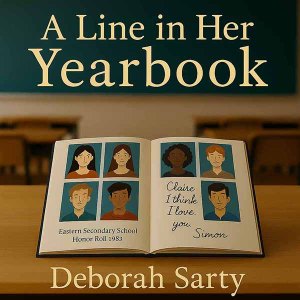
The memory of the note he’d written in her yearbook that year crowded in. She thought about echoing it in his copy, but opted for humor. “Well, Simon,” she grinned, signing her name. “Thank you for coming. Happy reading.” She snapped the book shut before he could read it.
He flipped to the inscription and guffawed. “To Simon, God among men—at least to himself.“
He grinned. She grinned. Behind them, titters and chatter grew.
“Well.” He noticed the expectant eyes behind him. “I’m being a nuisance. Would you grab a coffee with me? After? To catch up?”
She hesitated.
“Have coffee with him,” someone called from down the line.
“What the heck,” she said, huffing out a breath. “Mustn’t disappoint these ladies.” She checked her watch. “I’m finished in an hour. There’s a Tim Hortons two doors down. I’ll meet you there.”
“It’s a date.” He hoisted her book in a salute and left.
“I bet he makes it into your next book,” someone sighed.
‘I’ve got news for you, ladies.” She laughed. “You’ll all probably make it into my books.” She reached for the next one. “Hi. I’m Claire.”
***
She entered the coffee shop and stopped, scanning the tables. Would he be here? Or was he merely being polite earlier. Did he come, saw that she was as old as he was, satisfied his curiosity, then left?
But no. There he was, in the back, standing and waving to get her attention. Two mugs of coffee sat on the table. She didn’t like coffee, but she appreciated the thought. When she reached him, he leaned in for a quick peck on her cheek. Friendly. Not sexual. She didn’t return it. Just sat.
“I wasn’t sure you’d be here,” she said, loading her coffee with enough sugar and cream to bake a cake, hoping it would mask the bitter taste.
He sat back, still all long limbs and interesting face. Not handsome, but rich in character. Time had carved years around the eyes and mouth, and what was left of his hair was mostly grey.
“I came into town to find you. Why wouldn’t I come?”
His words sent ripples of unease through her stomach. She leaned back, putting distance between them. “So—not a chance meeting?”
“No, ” he agreed. “I’m visiting my son and his family in Lethbridge, saw your poster for the signing here in Calgary, and thought, why not?”
His pause stretched.
She wasn’t sure what to say—in her novels, she was confident and witty—so she swished her coffee and said the inane. “Long drive.”
“I can’t believe we’re sitting here after all these years,” he said. “Don’t get me wrong. I loved Mary—my wife—every year of the five decades we were together. But there has always been, at the back of my mind…what if? You know?”
She knew. When she’d found the yearbook two months ago, with his note—I think I love you—she’d wondered too. What if?
If they’d gone to see a different movie, one that didn’t reduce her to tears, that didn’t make her feel vulnerable and embarrassed afterwards.
If she hadn’t lied to him the next day and said the movie was sentimental tripe.
Or if he’d asked her why, and heard her fears of being dismissed as an emotional woman.
Yes, she knew.
“It was just one date,” she said. “Not much to base what if on.”
“Why did you lie the next day? It confused me.” He rested his chin on his hand, studying her. “You cried when Ali McGraw died, when Ryan O’Neal was devastated. I cried too. Then the next day, you called it sentimental drivel.”
She studied her hands, moved them to her lap. “You didn’t get me.” Her laugh was low and full of old pain. “It was a man’s world back then. Do you remember what a fierce feminist I was?” She chuckled. “If I’d had a bra to burn, I’d have tossed it on the heap.” She risked a glance, saw interest but no judgment. “I wanted desperately to break through that glass ceiling—but I couldn’t if I was branded as emotional.”
“I didn’t know.” He reached across to touch her hand.
She pulled it away. “You didn’t ask.” That wasn’t fair. “Sorry. I could have explained.” Feeling braver, she reached out and touched his hand for a second before reclaiming her space. “I admired you. You were smart—as smart as me—smarter, even. I wanted your respect more than anything. And I thought crying at a stupid movie was the wrong way to win it.”
She held her cup as if it were a life preserver. “I made a mistake. But when you ghosted me after, I was angry. Hurt. Confused.” Her head tilted. “I never read that note you wrote in my yearbook.”
He sat back, stunned. “You never read it? I always assumed you had.” His laugh was rueful. “I should have said it out loud.”
She reached across again and left her hand on his. “Don’t beat yourself up. We were both dumb kids, afraid to speak our truth.” She’d left anger behind a long time ago, though he’d never left her mind. Now and then she’d googled him, kept up with his life, but never reached out.
He covered hers with his warm, strong, secure hand. “Mary loved your books,” he said. “There was always one kicking around the house. I read the author bio. It didn’t tell me a damn thing. But I was happy to see you successful. In school, I thought you could do anything you set your mind to. And I was right. You did.”
She chuckled, withdrew her hand, but let it stay near. “I doubt either of us thought I’d end up a novelist. I hated English class. Remember? Mr. Willis blathering on about why Kane’s sled was red or blue—or whatever. I mean, who cares?”
“I remember.” His laugh was deep and hearty. “You frustrated that poor man. He didn’t know what to do about you.”
“Except suggest that I go into business instead of English Lit.” It felt good to laugh with him. “I wonder,” she said, with a lop-sided grin, “if others analyze my stories.” She shook her head. “I hope not. When I write, a sled is just a sled.”
“I’ve read a few of your books,” he confessed. “You’re deeper than you let on. Your characters are complex. Real. They draw you in, make you care. And that sled? It’s never just a sled.”
She laughed, pleased with the compliment.
He tilted his head. Chasing a thought, perhaps? “When you’re in what-if mode, do you think we’d have been good together? If we’d talked back then?”
Rubbing her lobe bought her time to think, to choose her words. “Not really. Did you?”
One shoulder dipped. “I don’t know. How could I tell? We were so young.”
“We were,” she agreed. “If you’d asked me back then, I’d have said yes, we’d be great together. But that was youth talking.”
“And today? You think differently?”
Her hand moved in a gesture of certainty. “I know so. Today. We wanted different things back then. You wanted family. Talked about it all the time—wife, children. I didn’t.” She rolled her neck, easing away the day’s tension. “Remember? I told anyone who’d listen that I’d never marry, never have kids. And I didn’t.”
“Oh,” he said. “I remember you saying that—now. But I didn’t think you meant it.” He opened the book to the inside back cover and her bio blurb. “Says here you were married for forty years.”
She brushed the comment aside. “We were common law. It’s the same thing but we never got that piece of paper. It mattered, that distinction, to me, at least. Nate was okay with it. He never asked me to be anyone but myself.”
“You’re right,” he agreed. “I’d never have been okay with it.” He tucked her book under his arm, his cue that it was time to go. “I’m glad we had this talk. I mean it.” He brushed her arm. “When Mary passed, I—well—I started to wonder. That’s why I came to your book signing today.”
“And now?” She hoped he’d gotten closure today, as she had.
“I see both of us as we are, not as my imagination created. I’ve had a good life. I was married to a wonderful woman. Maybe when the time is right, I’ll find another.” He laughed. “That makes it sound like you aren’t. Wonderful, I mean. You are. Just—not with me. And me, not with you.”
“Exactly. You’re an unforgettable acquaintance from a day too far back in memory. Still, I’m glad you stopped by.”
They rose together, walked to the door.
“That line you wrote in my yearbook—I think I love you. The truest word was think. It was just a passing thought. And I’m glad we both let it pass.”
He nodded as they pushed through the door. “I see that now.” He turned, held his hand out, waited until she clasped it. “I’m glad you’ve had—are having—a great life, Claire.”
“I’m glad for you, too, Simon. I hope you find that second wonderful woman. You deserve it.”
He walked away, heading to the LRT. Her car was the other way.
“Fitting,” she thought, smiling as she turned and walked to her car, the encounter already forming a story in her mind.
The End
© Deborah Sarty. All rights reserved. This story may not be reproduced without permission.
Enjoyed this story? New short fiction appears first in Deb’s Quill, my free monthly newsletter.
 Deb's Quill