His bedroom was exactly as Mom left it before she died. The same heavy oak furniture, the same family photos on the walls, the same rose bedding. The difference was Dad, naked, lying on the floor, one leg bent at an awkward angle. His yellowed skin had melded to bone, and he reeked of urine and feces.
Diedre gagged, swallowed her bile and knelt beside him.
“I’ve called the ambulance, Dad,” she said, “but it’s twenty minutes out. Can you move your legs or wiggle your toes?”
His voice was weak and whisper-soft. “Can you straighten my leg? Nothing’s broken, but it’s gone numb.”
“I wish I was strong enough to lift you back into bed, Dad.” She straightened his leg and placed a pillow under his head. “This will have to do.”
“Teddy should be here,” he said. “He could lift me.”
She snorted. “Right. Teddy moved away for a reason.”
His jaw jutted up. “He blames me for your mother’s death.”
She looked into his eyes. “So do I.”
He looked away. His Adam’s apple moved up and down, up and down as tears pooled in his eyes. “Me too.”
She nodded.
“I’ve replayed that night in my head a thousand times. Don’t remember taking that first drink.”
“You never do.”
She ignored his quiet sob and walked through the house. Nothing had changed here, either. The cleaning supplies still sat under the kitchen counter, unused for ages. But the house was clean, she’d give him that.
His eyes were closed when she got back to his room, but the skin underneath was damp.
She knelt beside him, soap and washcloth in hand. Colour flushed her cheeks as she moved his flaccid penis to the side and started cleaning.
She wiped her sponge down paper-thin skin and sparse pubic hair. She hadn’t known that hair everywhere receded with age.
“I’m cold. Can you cover me?”
She avoided his eyes. “Not yet. Sorry. I have to clean you first.”
She dipped her sponge in the pail, squeezed the water out. Dribbles ran down her arm. “The doctors said …”
“I know what they said,” he ground out, wincing. “You’re rough.”
“Sorry.” She gentled her hand.
“I’ve wanted to say this ever since she died,” and stared until he returned her gaze. “If you hadn’t been drunk when Mom had her stroke, maybe …”
He snatched the sponge from her hand in a burst of strength that surprised her. “You think I don’t tell myself that – every day – every damn hour – since?”
He tossed the sponge into the pail and sank back, breathing heavily. “Haven’t had a drink since.”
“Oh, well, then. I guess that makes everything all right.”
She worked in silence.
Her hand hovered over his genitals.
“I work with this older man,” she said. “Close to your age. He jokes with his daughter. ‘I changed your diapers when you were a baby,’ he told her, ‘and soon you’ll get to change mine.’ I laughed at the time.”
“Getting old isn’t funny. It bloody sucks!”
“Yes. Well ….” Wipe. Clean the sponge. Repeat.
“I didn’t think you’d come.”
“I almost didn’t.” She glanced up. “But Mom made me promise a long time ago to help you if you asked. Back then, I figured you’d go first, so I agreed.”
She caught his eye. “It’s a promise I’ve regretted ever since.”
She rose and carried the dirty water to the bathroom and flushed it down. Refilled it. Returned to him and her task.
“I’m going to have to shift you a bit, Dad. To clean underneath. It might hurt a bit.”
She rocked back on her heels, and sat, eyes on her hands. She’d changed Amalie’s diapers. This was the same. And yet, it was so much harder.
He cried out as she rolled him to one side.
“Twenty minutes,” he gasped.
She glanced at her watch. “Fifteen now.”
The first glob of feces plopped into the pail.
“If you’d moved to Trenton like Mom wanted, they’d have been here by now.”
“I built this place. It’s mine.”
“I know,” she sighed.
She and Teddy had helped. Painting the outside, her ten-year-old hands barely making a dent. Teddy, two years older, had reached higher, worked faster. Try as hard as she could, she couldn’t match her brother’s speed.
She’d loved Dad then. Loved this place, too, and thought one day, she’d buy it and live here in the countryside. Raise goats and horses like Dad did. No turkeys, though. She’d cook ham for Thanksgiving first, rather than raise those stupid birds.
He gasped, and his back arched.
“Did the doctors give you something for the pain? Tell me where it is, and I’ll fetch it.”
He didn’t answer. His breathing was short, shallow, ragged.
“Never mind. I’ll find it.”
“No point,” he ground out, grabbing her arm, keeping her in place. “Doesn’t help. Damn pills stopped working months ago.”
“I’m sorry. But we always figured you’d end up this way,” she said. “Not like you didn’t have a role model. What did Grandad die from? Cancer? Cirrhosis?”
“Cirrhosis.” A cough tore out of his chest, a drop of blood in his spittle. He wiped it away. “Not what’s getting me, though.”
She dropped more feces into the pail, caught his eye and waited. He rolled onto his other side.
“Cancer.”
“Ah. Beer and cigarettes. A match made in heaven.”
“Sarcasm was always your worst feature. You know that?”
“So I’m told.”
A lone tear rolled down his cheek. “I think this is it.”
She glanced up, then resumed her task. “Maybe.”
She finished cleaning him, set the pail aside and pulled a blanket from the bed. “This should help.”
“Thank you.”
“Sure. No problem.”
Her phone rang. Her daughter, Amalie. She gathered the pail and retreated to the hall. “Hi, Sweetheart. Is everything okay?” A smile stretched across her face. “Congratulations! I’m so proud of you. Does Dad know? I won’t be long. Let’s all celebrate when I get home. Love you both.”
She dialled her husband. “Carl, you heard? Yes. She’s so excited. Let’s take her to Chi Chi’s tonight. Wonderful. No, no. The ambulance will be here soon. Okay. Bye, love.”
Pocketing her cell, she emptied the pail into the toilet, cleaned it, and put it back under the kitchen sink.
She looked in on him. “Ten more minutes, Dad.” She started to close the bedroom door.
“Will you stay with me?” he gasped.
She looked down the hallway. Looked at him. Stood for moments with her hand on the doorknob. “Of course,” she sighed. Then she entered and sat on the bed across from him.
“We had fun when you were little, didn’t we?” he said. “Remember the camping trips? You used to love that.”
She barked out a laugh. “I hated camping.”
He winced. “You didn’t. Every time I suggested it, you always said yes.”
She looked at him, small, helpless, dying. She should soften the blow. “I was a kid. Didn’t think I had a choice.”
He tried to prop himself up, but his arms failed. “Bullshit.”
He stared until she was forced to look at him. “You saying we never did anything together that you liked?”
Another shrug. “I wanted you to cheer me on at basketball. The year we went to Regionals, you promised to be there. Instead, you went on one of your binges, passed out somewhere along the side of Hwy 30, and spent the night in Brighton’s jail.”
“I don’t remember that,” he whispered.
“Of course not. You were plastered. As usual.”
“Guess I deserve that.”
He winced. His eyes snapped shut, and his mouth contorted.
She touched his arm. “I’ll see if I can find some Advil. It might help.”
“It won’t,” he gasped.
She felt every bone in his hand as he laid it on her arm. “It won’t be long, Dad. Just hang in, okay?”
“What for? You never visit. You’re only here now because your mother made you promise. The silence in this house – I can’t stand it.”
“You made your bed.”
He croaked out a laugh. “That’s your mother’s favourite phrase.”
She smiled. “It was.”
“The way you tell it, I was never there for you.”
She shrugged.
“There has to be something we did together that made you happy.”
Her wedding. “You walked me down the aisle. You didn’t drink that night, and we had a wonderful father-daughter dance.” She met his eyes, both of them teary. “I was so wrapped up in Carl and me that I never thanked you for that.”
“You didn’t need to. You were so beautiful.” He squeezed her arm. “Still are.”
“You came to my graduation, too. I heard your cheers out-yelling everyone else.”
His laugh turned into a cough. “My baby was up on that stage. What else was I going to do.”
He sighed. “I haven’t seen Amalie in years. Will you bring her to the hospital? So I can say goodbye?”
She clenched her teeth. “The last time Amalie was here – what? Ten years ago, I think. You were drunk and belligerent. You punched Carl in the eye. Scared my baby half to death.”
“I don’t remember that.”
“Stop saying that,” she raged, “like it excuses your behaviour. It doesn’t.”
He flinched. “I know. I try to resist. Most of the time I do. Doesn’t that count?”
“No. Because you could have gotten help. Gone to AA. We’d all have helped you if you’d done that. But mentioning it just enraged you.”
He looked away. “Thought I could do it on my own.”
“Whatever.”
She rose. “I think I hear something. Let me check on the ambulance.”
She met the EMT crew in the driveway and guided them with their gurney into the house.
“You folks live pretty far out,” the driver said.
“He does. Not where he should be living at his age. But I get it. There’s something special about this place.”
She opened the bedroom door. “He fell out of bed and couldn’t get up. And I couldn’t lift him. Has cancer, he says.”
“You related?” the lead EMT asked.
“Daughter.”
“Can you tell me about his meds?”
She looked away. “No idea. But I can give you the bottles, if that helps.”
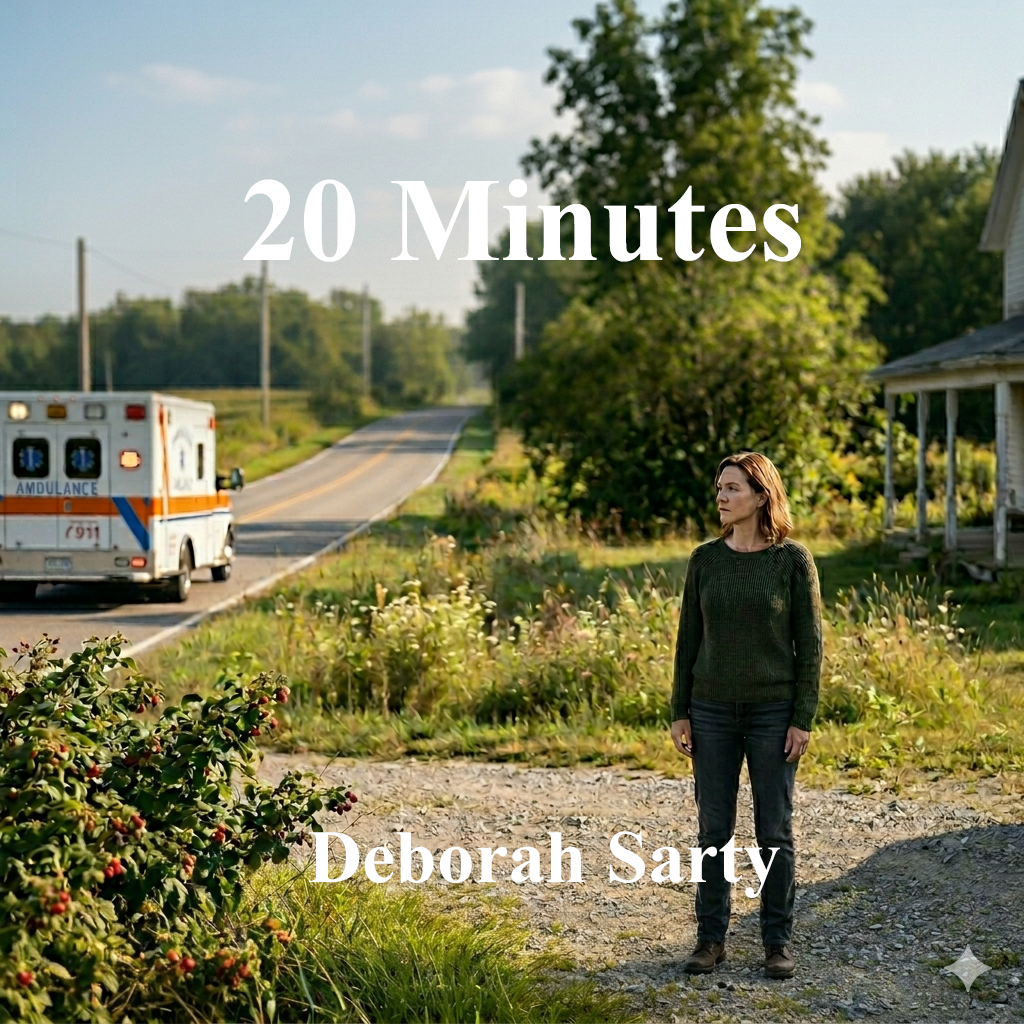
That chore done, she left them to it, retreated to the living room and stood looking out the window. She and Teddy used to steal raspberries from wild bushes across the road. She could still taste the sweet tang of her mother’s raspberry cobbler.
She saw a corner of her dad’s south acreage. This time of year, his flowers should have been in full bloom, but all she saw were husks where colour should have been.
She remembered Carl courting her here. He stole some of Dad’s flowers and presented them to her, as if they, and she, were the most precious things in his life. Like he and Amalie were in hers.
She heard movement behind her and turned. The EMTs wheeled her father outside and down the stairs to the ambulance. She grabbed her bag and followed.
They paused to open the ambulance doors. Her father grabbed her wrist. “Will you come to the hospital with me?”
“Look after him,” her mother had asked. She’d promised. But she hadn’t, not really. She and Carl could have helped with the flower bed. Could have fetched his groceries. Could have – done more.
She covered his hand with hers. Just for a moment. “I don’t know.”
Then they loaded him into the ambulance. She stepped back, tears welling, and watched them drive away.
In her car, she let them fall. Unchecked.
She looked out over the fields, waist-high grass swaying in the morning breeze. Dad should have been on his tractor, mowing it down. He’d taught Teddy to drive the tractor and when Dad was away, Teddy had taught her. Dad had yelled at Teddy but had winked at her.
Her phone buzzed. She blew her nose and wiped her eyes. She opened Amalie’s message: a photo of Amalie and Carl, his arm around her shoulders, her acceptance letter from Western held proudly in front. She smiled, touched her lips, then saved it to her album.
She put the car in gear and drove home. They’d help her decide what to do.
© Deborah Sarty. All rights reserved. This story may not be reproduced without permission.
Did you enjoy this story? Deb’s Quill features one new story each month. Be the first to read it. Subscribe now.

